Showing posts with label biochemistry. Show all posts
Showing posts with label biochemistry. Show all posts
Glycolysis
Conversion of pyruvate to lactate occurs under anaerobic conditions, as full oxidation by the mitochondria is not possible in the absence of oxygen. By converting pyruvate to lactate, NAD+ is regenerated from NADH, allowing glycolysis to continue. Glycolysis itself produces ATP, although less so than mitochonrial oxidation, and supplies energy under anaerobic conditions. The lactate that is produced is recycled to the liver where it is reconverted to glucose. FADH2 and NADPH are not produced by glycolysis. Adrenaline stimulates muscle glycogenolysis, providing a local supply of glucose that is used by glycolysis.

Uric acid
Uric acid is the degradation product of the purine bases. Orotidine contains a pyrimidine ring and is not degraded by this pathway.
Guanine is metabolized to xanthine, and thence to uric acid.
Adenosine is converted via inosine and hypoxanthine to xanthine, and thence to uric acid.
Guanine is metabolized to xanthine, and thence to uric acid.
Adenosine is converted via inosine and hypoxanthine to xanthine, and thence to uric acid.
Disulphide Bridges
Disulphide bridges are covalent bonds formed between pairs of cysteine residues (forming cystine). These contribute to the tertiary structure of proteins by linking distant regions of a protein. Disulphide bridges may also occur between different peptide chains within a protein, e.g. between the A and B chains of insulin. They are common in extracellular proteins, but less common in intracellular proteins. Strong reducing agents are required to break the disulphide bridges.
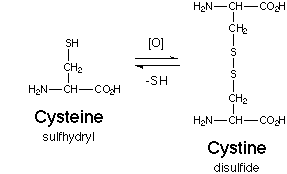 |
| Fig 1: Cysteine and Cystine |
 |
| Fig 1: Disulphide Bridge |

Source: Fig 1, Fig 2, Fig 3,


Subscribe to:
Posts (Atom)